


The field of artificial intelligence is evolving rapidly. In 2026, developers will require an appropriate set of machine learning tools. They can help create a high-quality product without spending much time on it. Today, there are numerous advanced machine learning tools that support all processes. From data preparation to model monitoring, developers can easily integrate all the necessary aspects of AI creation into their project. When comparing machine learning vs AI, machine learning is a subset that focuses on learning from data, while AI is the broader concept of building intelligent systems. Understanding this difference helps developers choose the right tools based on whether they need rule-based logic or data-driven learning.
- What Are Machine Learning Tools & Why Do They Matter for Developers?
- What Are the Best Machine Learning Tools You Should Use in 2026?
- TensorFlow
- PyTorch
- Scikit-Learn
- Amazon SageMaker
- Google Vertex AI
- Microsoft Azure Machine Learning
- IBM Watsonx.ai
- H2O.ai
- Dataiku
- AutoGluon
- What Key Features Should You Look for in Machine Learning Tools?
- Which Machine Learning Tool Is the Right Fit for Your Project?
- What Trends Are Shaping Machine Learning Tools in 2026?
- Conclusion
- Frequently Asked Questions (FAQs)
In this article, readers will gain insights into the Best Machine Learning Tools in 2026 for Developers featured on BFM Times.
What Are Machine Learning Tools & Why Do They Matter for Developers?
Machine learning tools are software and frameworks used to build and develop AI applications. They help solve various problems associated with data analysis and modeling. The tools have many algorithms and utilities that simplify data processing. With the right machine learning software, developers get the opportunity to speed up their work and avoid any issues.
These tools are important because they make the process of building AI products simpler and more accessible. Without machine learning platforms, building an AI solution would be very difficult for specialists. There are plenty of companies in the field of healthcare, finance, e-commerce, and other areas using machine learning tools daily. Machine learning business use cases include demand forecasting, customer segmentation, and fraud detection.
These applications help companies turn data into actionable insights and improve decision-making processes.
What Are the Best Machine Learning Tools You Should Use in 2026?
| Tool | Best For | Pricing | Open Source |
| TensorFlow | Deep learning & neural networks | Free | Yes |
| PyTorch | Research & rapid prototyping | Free | Yes |
| Scikit-Learn | Traditional ML tasks & beginners | Free | Yes |
| Amazon SageMaker | Enterprise AWS workflows | Pay-as-you-go | No |
| Google Vertex AI | Cloud-native ML on GCP | Pay-as-you-go | No |
| Azure ML | Microsoft ecosystem users | Pay-as-you-go | No |
| IBM Watsonx.ai | Governed enterprise AI | Enterprise pricing | Partial |
| H2O.ai | AutoML & big data | Free + Paid plans | Yes |
| Dataiku | Team collaboration & MLOps | Enterprise pricing | No |
| AutoGluon | Automated model building | Free | Yes |
TensorFlow
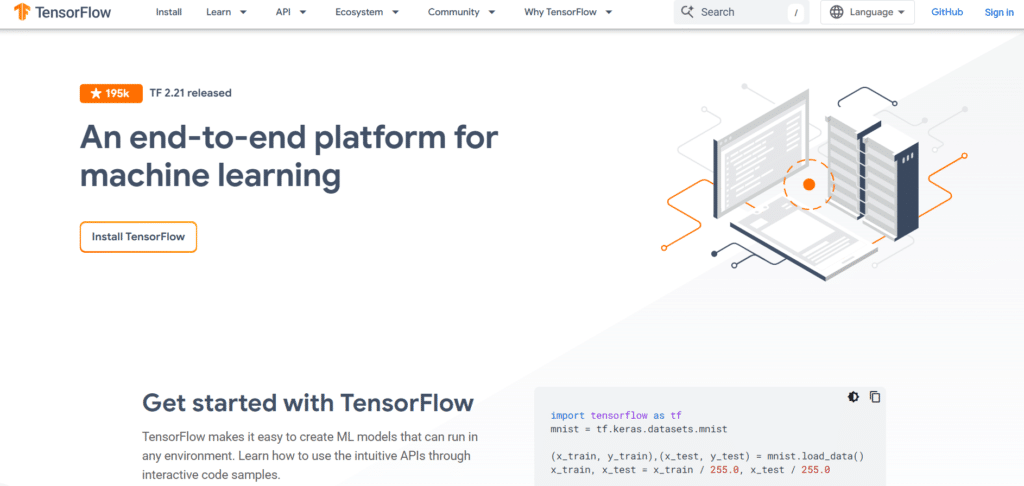
TensorFlow refers to one of the most popular machine learning solutions of the day. This tool was created by Google Brain and has a large open-source community of enthusiasts supporting it. TensorFlow is able to manage deep learning, neural networks, and model training at scale. It is able to support GPU acceleration and has integration with Keras. Developers working with computer vision and NLP prefer to use TensorFlow in their products.
Key Features
- It supports deep learning & large-scale neural network training.
- It offers strong GPU acceleration support.
- It integrates with Keras for faster prototyping.
- It runs on multiple platforms, including mobile & web.
- It has a massive open-source community with regular updates.
Best For: Deep learning, computer vision & natural language processing.
Visit Website: TensorFlow
PyTorch
PyTorch refers to another excellent machine learning solution used by professionals around the globe. Originally, this tool was created by the Meta AI research lab. It uses a dynamic computational graph that allows model developers to create AI more conveniently and debug it easily. It has Pythonic syntax and can operate with GPU training. Today, the most popular AI models were built using PyTorch.
Key Features
- It uses a dynamic computational graph for flexible model building.
- It supports GPU training & distributed computing.
- It has Pythonic syntax that feels natural to developers.
- It provides strong support for NLP & computer vision tasks.
- It is widely adopted by top AI research teams globally.
Best For: Research, rapid prototyping & flexible model experimentation.
Visit Website: PyTorch
Scikit-Learn
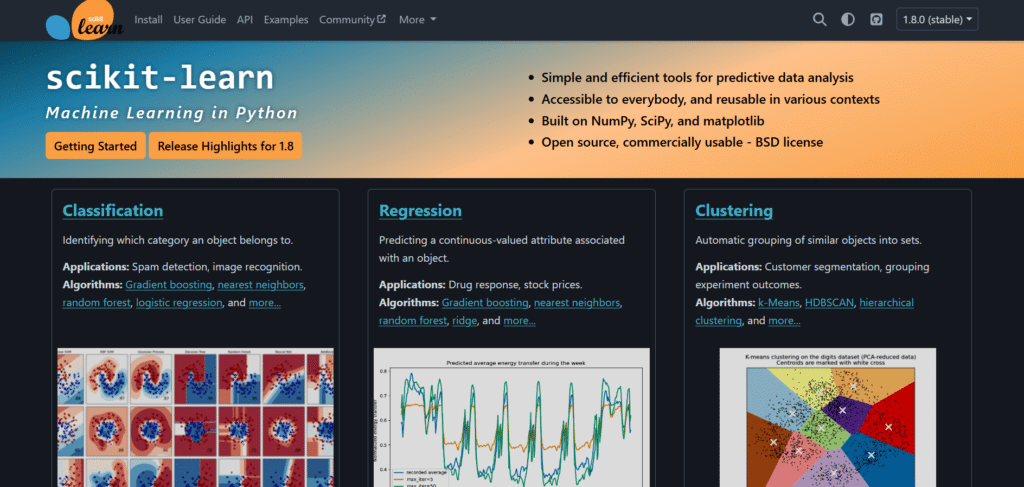
Scikit-Learn is one of the top beginner-friendly tools for machine learning that can be used by professionals. This framework is built on NumPy, SciPy, and Pandas. It offers convenient APIs for solving typical ML tasks such as classification, regression, and clustering. Documentation of the software is extremely understandable. If you want to enter the world of machine learning, then you should know about Scikit-Learn.
Key Features
- It provides simple & intuitive APIs for classification, regression & clustering.
- It is built on top of NumPy, SciPy & Pandas.
- It offers clear & easy-to-follow documentation.
- It supports a wide range of supervised & unsupervised learning algorithms.
- It is completely free & open source.
Best For: Beginners, traditional ML tasks & data preprocessing.
Visit Website: Scikit-Learn
Amazon SageMaker
Amazon SageMaker refers to a completely managed machine learning platform from AWS. With this product, developers receive all the necessary functions for working in the field of ML. The service includes such components as SageMaker Pipelines and Model Monitor that automate CI/CD pipelines and track ML models after deployment. Developers using AWS infrastructure can greatly benefit from SageMaker.
Key Features
- It covers the complete ML lifecycle from data prep to deployment.
- It includes SageMaker Pipelines for automating CI/CD workflows.
- It offers Model Monitor for tracking model health after deployment.
- It supports TensorFlow, PyTorch & Scikit-Learn frameworks.
- It provides scalable hosting endpoints with auto-scaling.
Best For: Enterprise teams using AWS infrastructure & full ML lifecycle management.
Visit Website: Amazon SageMaker
Google Vertex AI
Vertex AI refers to Google Cloud’s unified platform for solving problems related to machine learning. With this software, users receive the opportunity to combine AutoML and custom model training. Also, the platform is integrated with BigQuery, Dataflow, and other cloud tools from the company. Users can reduce the time needed for moving from training to the production stage. It also supports all aspects of MLOps.
Key Features
- It combines AutoML & custom model training in one place.
- It integrates with BigQuery, Dataflow & other Google Cloud services.
- It supports model deployment, monitoring & version management.
- It enables efficient training on very large datasets.
- It supports MLOps best practices right out of the box.
Best For: Teams on Google Cloud needing end-to-end ML & MLOps support.
Visit Website: Google Vertex AI
Microsoft Azure Machine Learning
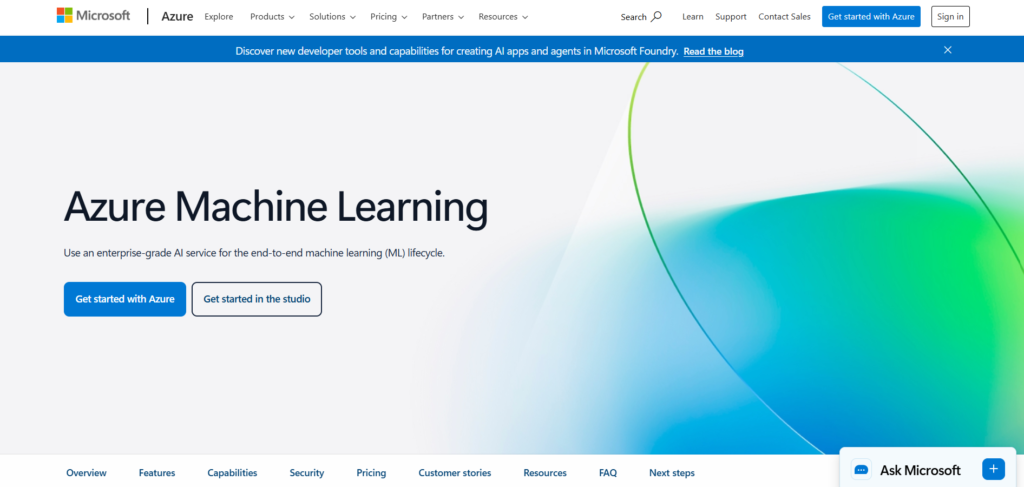
Azure Machine Learning is an end-to-end machine learning platform offered by Microsoft. The service allows drag-and-drop model creation and has built-in functionality for automation via AutoML. Azure ML can work together with TensorFlow, PyTorch, and Jupyter notebooks. Teams working in enterprise environments greatly appreciate this solution due to its powerful security and compliance options.
Key Features
- It supports drag-and-drop model design through a visual designer.
- It includes AutoML for automated model building.
- It integrates with TensorFlow, PyTorch & Jupyter notebooks.
- It connects with Power BI, Excel & the wider Microsoft ecosystem.
- It offers strong security & compliance features for enterprise use.
Best For: Enterprise teams using the Microsoft & Power BI ecosystem.
Visit Website: Azure Machine Learning
IBM Watsonx.ai
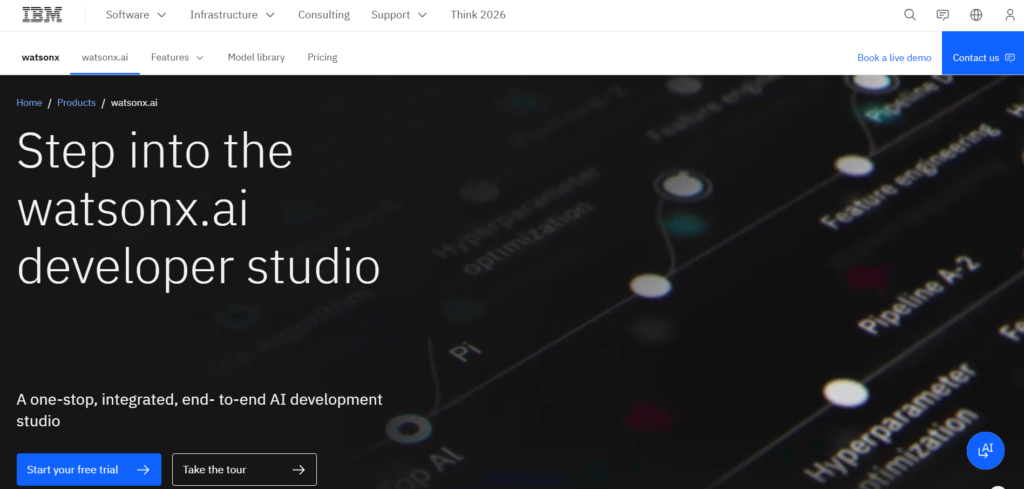
Watsonx.ai by IBM refers to a new AI platform that combines classical machine learning and generative AI. The solution includes all processes in the AI lifecycle and allows building responsible AI with governance. The platform can work perfectly in the sphere of banking and healthcare, where regulation plays a critical role. This platform is considered one of the top tools in 2026.
Key Features
- It supports the full AI lifecycle, including training, tuning & deployment.
- It includes tools for building & fine-tuning foundation models.
- It is designed for governance, transparency & responsible AI.
- It integrates with IBM Cloud & open-source frameworks.
- It works well in banking, healthcare & compliance-heavy sectors.
Best For: Regulated industries needing governed & responsible AI workflows.
Visit Website: IBM Watsonx.ai
H2O.ai
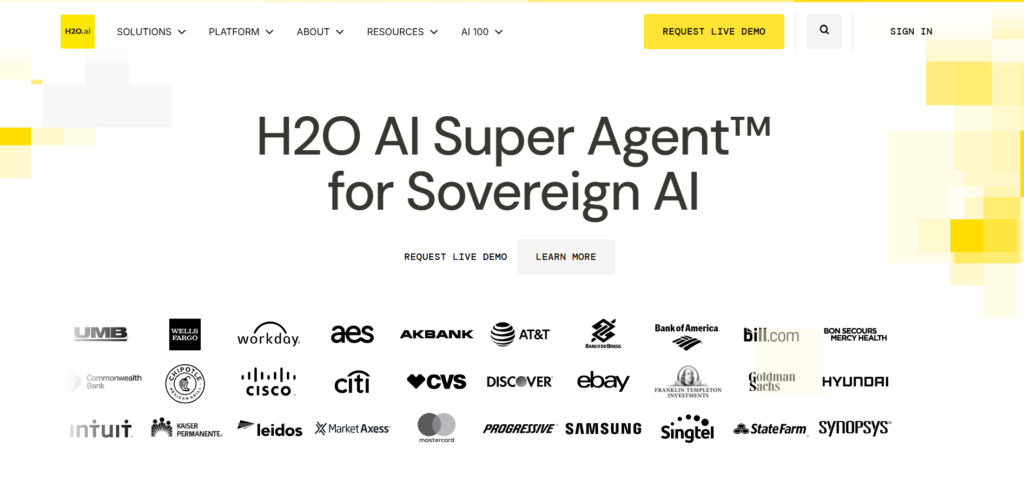
H2O.ai is a fast model-building machine learning platform. The platform comes with AutoML features for automatic model selection and tuning. It runs on Hadoop, Spark, and cloud environments. In terms of machine learning tools, this option proves to be very reliable.
Key Features
- It offers AutoML features for automatic model selection & tuning.
- It runs on Hadoop, Spark & cloud environments.
- It supports both R & Python integration.
- It handles large datasets with high efficiency.
- It is open source & available with free & paid plans.
Best For: Data scientists who need fast AutoML & big data model building.
Visit Website: H2O.ai
Dataiku
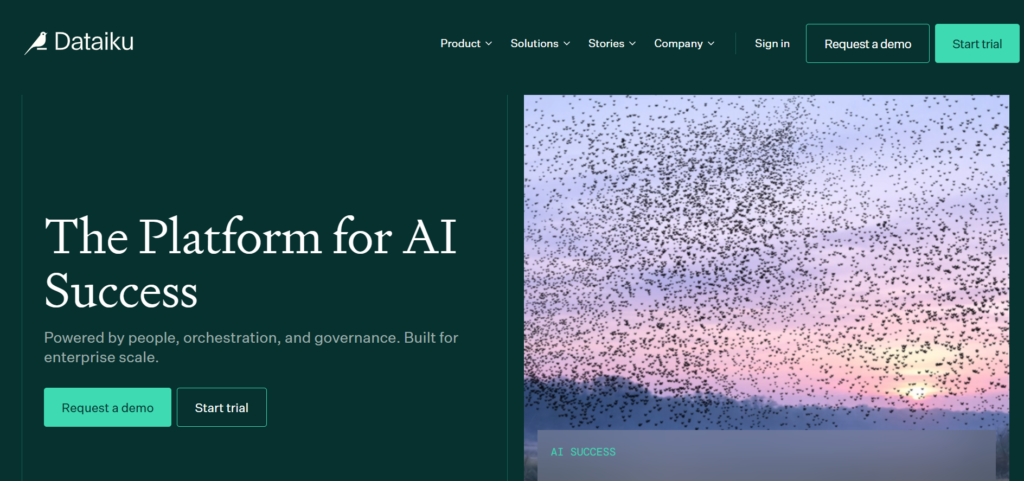
This collaborative data science platform brings together data engineers, analysts, and ML engineers into a single workspace. It includes both visual and code-based model building and has excellent MLOps capabilities. Those who need collaboration in machine learning tools should check out this platform.
Key Features
- It brings together data engineers, analysts & ML engineers in one workspace.
- It supports both visual & code-based model building.
- It offers strong MLOps features for deployment & monitoring.
- It integrates with most major cloud platforms.
- It is widely used in retail, finance & manufacturing sectors.
Best For: Teams that need collaborative data science & strong MLOps features.
Visit Website: Dataiku
AutoGluon
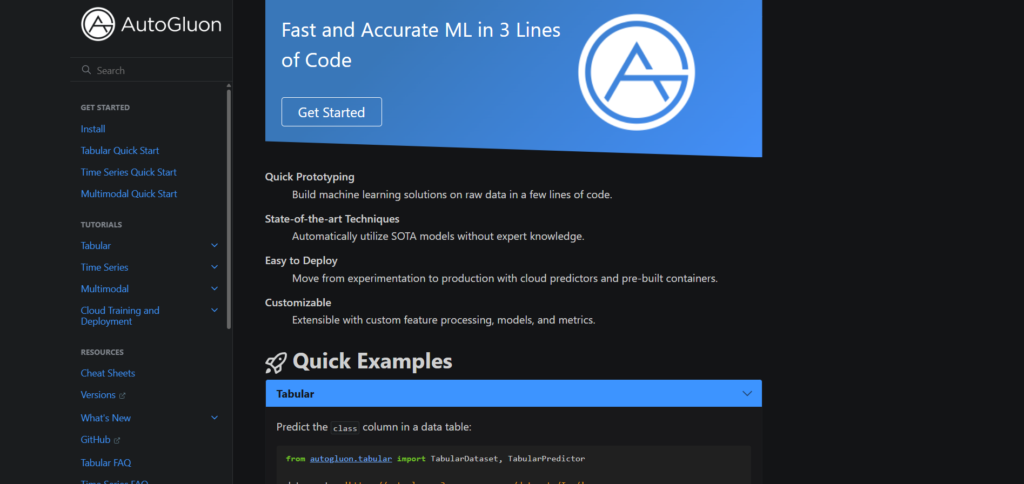
AutoGluon is an open-source platform for automated model building. It allows for automated handling of the selection and tuning of models. AutoGluon can work with tabular data, text, image, and time-series data. It is becoming extremely popular among machine learning tools in 2026 because of its efficiency.
Key Features
- It works with tabular data, text, images & time series.
- It automatically handles model selection, feature engineering & tuning.
- It delivers strong predictive results with very little manual setup.
- It reduces time spent on repetitive ML tasks.
- It is completely free & open source.
Best For: Developers who want automated & fast model building with minimal effort.
Visit Website: AutoGluon
Deep learning software enables developers to build models that can process large and complex datasets using neural networks. These tools are essential for applications like speech recognition, computer vision, and AI assistants.
What Key Features Should You Look for in Machine Learning Tools?
The most reliable machine learning tools have certain things in common. Knowing these features will enable developers to choose the right tools before facing any problems.
| Feature | Why It Matters |
| Scalability | Can handle increasing amounts of data with no performance issues |
| Ease of Use | Reduces the time spent learning a new tool for new developers |
| Integration Support | Well-integrated with other technologies used |
| AutoML Capabilities | Can automatically perform certain tasks, including model tuning |
| Deployment Options | Can deploy models to different environments such as cloud, on-premises, and edge |
| Monitoring & Logging | Allows monitoring of models after they’ve been deployed |
| Community Support | Provides continuous assistance and updates |
These features affect how effective machine learning tools are. They also determine whether the platform is worth investing in in the long run.
Which Machine Learning Tool Is the Right Fit for Your Project?
Selecting the right machine learning tool comes down to your team’s skills, project goals, and the infrastructure you have in place.
Beginner developers can start with Scikit-learn, as it offers a simple introduction to machine learning without being overwhelming. Those focusing on deep learning projects should choose between TensorFlow and PyTorch because they are powerful and flexible.
If your team is already working within AWS, choosing Amazon SageMaker makes sense due to its strong integration with the AWS ecosystem. Similarly, if you’re using Google Cloud, Vertex AI is a perfect choice since it contains all the needed components.
If you need enterprise-level features for governance and compliance, IBM watsonx.ai is a strong option. Finally, those who care about collaboration should check out Dataiku.
When comparing machine learning vs deep learning, deep learning is a more advanced subset that uses neural networks to handle complex data. While ML works well with structured data, deep learning excels in tasks like image recognition and natural language processing.
What Trends Are Shaping Machine Learning Tools in 2026?
There’s a lot of activity and innovation happening around machine learning tools in 2026. There are several main trends affecting these technologies.
AutoML is quickly becoming a key feature for platforms looking to attract more users. Most platforms today contain some form of automated capabilities. MLOps has also become a necessary feature for machine learning tools. Monitoring and deployment alone are insufficient nowadays.
Enterprise-ready open-source machine learning tools are gaining widespread popularity. Both PyTorch and TensorFlow have reached enterprise-grade status and can be used for large-scale deployments. Generative AI has recently integrated with the majority of platforms, such as IBM Watsonx.ai and Google Vertex AI. Machine learning trends in 2026 focus on automation, scalability, and easier model deployment through cloud-based tools.
Technologies like AutoML and open-source frameworks are making ML more accessible to developers.
Lastly, GPU-powered cloud computing is becoming more accessible through on-demand services. Renting GPUs from the cloud providers is now easier than ever.
Conclusion
The right machine learning tools can make a significant difference in the success of any AI project. Machine learning tools help to build, deploy, and monitor models continuously. All machine learning tools listed in the article cover the requirements of any project. If you’re just getting started in ML development, Scikit-Learn or AutoGluon should be a good choice. In case you’re experienced and working with enterprise infrastructure, try out SageMaker, Vertex AI, or Watsonx.ai.
These are some of the top machine learning tools available to developers in 2026. These tools not only allow building great models but are also an essential part of any modern AI product. Choose wisely because it will help to reduce costs for your team and provide them with a solid framework to work with. Stay informed about recent developments, and you’ll never run out of great machine learning tools.
Frequently Asked Questions (FAQs)
What are the most popular machine learning tools in 2026?
Most popular machine learning tools in 2026 include TensorFlow, PyTorch, Scikit-Learn, Amazon SageMaker, and Google Vertex AI. All these machine learning tools are being used extensively by developers.
Which machine learning tool is best for beginners?
The most beginner-friendly ML tools in 2026 include Scikit-Learn. In addition, you might want to try out AutoGluon as it is highly beginner-friendly thanks to automated processes.
Are there free machine learning tools available for developers?
Yes, you can use TensorFlow, PyTorch, Scikit-Learn, H2O.ai, and AutoGluon for free. Cloud-based platforms, including SageMaker and Vertex AI, charge depending on usage.
Disclaimer: BFM Times acts as a source of information for knowledge purposes and does not claim to be a financial advisor. Kindly consult your financial advisor before investing.